True productivity
Longer hours stopped buying you better results a long time ago. Here are the 7 steps I use to choose where every hour goes, and get the rest of my life back.
By Vijay Bajaj | 30 October 2026 | 12 min read
In 2015 I started a new conference business. No evenings. No weekends. Most Fridays off.
Within a year, it was staging the largest business transformation and operational excellence conference for senior executives in the United States.
For the 24 years before that, I did the opposite. Early starts, late finishes, laptop open on Sunday night. I built 3 market-leading businesses that way, and it cost me my health, my friendships and very nearly my sense of who I was without work.
Same person. Same ambition. Far fewer hours. A bigger result.
What changed was not my work ethic. It was what I allowed into my hours.
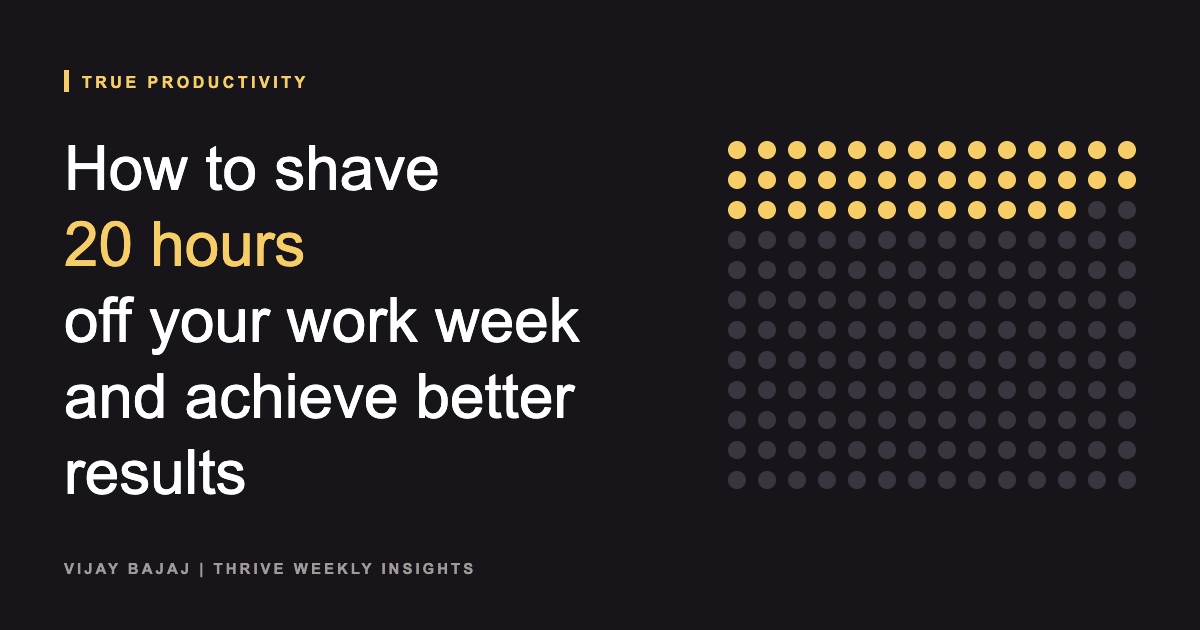
If you work 60 hours a week, getting to 40 gives you 20 hours back. This piece shows you how to get there, and how to make the 40 count for more than the 60 ever did.
The maths you cannot beat
You have 168 hours a week. So does every CEO you admire. So does every founder who seems to do it all and still make it home for dinner.
Your demands are bigger than your capacity. That is not a discipline problem. It is a maths problem. And getting up an hour earlier does not solve maths.
Based on 8 hours of sleep a night. Same 168 hours. 20 more of them belong to you.
Nobody can do it all. The moment you accept that, the question changes. It stops being “How do I fit it all in?” and becomes “What am I going to choose?”
Most high achievers never reach that second question. They spend years hunting for the app, the system or the morning routine that will finally make everything fit. It does not exist.
Why getting faster makes it worse
Productivity has been sold to you as efficiency. Do more in less time. Get faster.
Here is what happens when you get faster. You clear the list. By the evening it has grown back. Work expands to fill the time you give it. That is Parkinson’s Law, and most people only ever feel it working against them.
So speed gets rewarded with more work. More work becomes more hours. More hours become normal. That road has one destination, and it is overwhelm.
And there is a second trap underneath the first. The better you get at work you do not love, the more of it you are handed. You become the person who always sorts it out. Meanwhile the work only you can do waits for whatever energy is left at the end of the day.
What the long hours are costing you
This is not a feeling. It has been measured.
deaths from stroke and heart disease in a single year were linked to working 55 hours a week or more. A 29% rise since 2000.
higher risk of stroke for people working 55 hours or more, compared with 35 to 40 hours a week.
higher risk of dying from heart disease for the same people, working the same long weeks.
Source: World Health Organization and International Labour Organization, 2021.
And here is the part nobody mentions. The Stanford economist John Pencavel studied output against hours worked. Output per hour falls once the week passes about 50 hours. Someone working 70 hours produces little more than someone working 55.
Read that again. Those last 15 hours buy you almost nothing. You are paying full price for hours that produce fog, and you are paying with the very things you are working for.
The stories that keep you stuck
Before any method can work, the beliefs underneath it have to go. I lived by every one of these.
Later arrived in 2012. I exited my business, financially free. After 3 months I felt empty. After another 3, I fell into a depression.
If you have told the people you love “it is only for now” more than once this year, it is not a season. It is how you work now. And it is quietly becoming who you are.
What true productivity is
True productivity is choosing where your hours go, what you focus on and what you prioritise.
It is not doing less for the sake of it. It is not hiring your way out. It is the decision about what gets your attention in the first place, and almost nobody makes that decision on purpose.
What you put inside your hours matters more than how many you work. A 40-hour week of work that drains you will finish you faster than a 50-hour week of work you love and excel at.
That is the idea at the centre of everything that follows. Your Uncompetable Zone™ is the work you love and do better than anyone else. An hour there produces something nobody else could have produced in that hour. An hour outside it produces work someone else would have done better, and you pay for it twice. Once in the hour, and again in the energy it drains.
The 7 steps to shave 20 hours off your week
Each step builds on the one before it. Do them in order.
Set the boundary before you know how you will keep it
Most people wait for the system before they set the limit. Do it the other way round.
Parkinson’s Law has a useful side. Work also shrinks to fit the time you allow it. A firm finishing time forces the question an open-ended week never asks: out of all of this, what moves the needle?
When Microsoft Japan trialled a 4-day week in 2019, sales per employee rose by close to 40%. They did not find more hours. They set a limit, and the limit did the choosing.
Choose a fixed finishing time for every working day. Tell your partner. Tell your team. Then change the question you ask yourself. Stop asking “How do I get it all done?” Start asking “How do I get better results in the hours I have?”
Run every task through the Priority Test
3 questions. A task has to pass all 3.
Is it in my Uncompetable Zone? If someone else would do it better, it is not yours to do, however good you have become at it.
Does it move the needle? Does it deliver the highest return for your time, for you and for the business, right now? Most of what fills a week pays some return, which is why it feels worth doing. Treat the small returns and the big one as equal, and the small ones will eat the big one.
Does it matter now? Some work is yours and does drive results, but it belongs to next quarter, not this week. That work does not get dropped. It gets a date it comes back, and that date goes in your diary.
Clear the decks
This is where most people stall. You cannot simply stop doing everything that failed the test. Every task needs somewhere to go. There are 5 routes.
Dropping deserves more than a line. Build a Not-To-Do List across 5 categories: tasks, meetings, relationships, opportunities and diversions. The hardest entries are the opportunities, because they are good. That is exactly why they cost you so much.
Underneath all of this sits one skill: saying no. Say yes to what you are protecting. Give a clear no. Then offer another way to help, if there is one.
Hand off anything that costs less than your hour
Until you know what your hour is worth, every decision about handing something over is guesswork. So work it out.
÷
=
Do that for a year and the number stops being abstract. Then hand off in the right order.
Hand off from the outside in. Keep only what you love and do better than anyone.
2 rules make a handover stick. The first is the First and Last 10% Rule.
The brief is yours. The finish is yours. The middle is theirs.
The second rule: name the level you are handing over at, anywhere from “do exactly what I say” to “decide, and there is no need to tell me”. Most delegation fails because nobody named the level.
Protect your first 3 hours
Choose tomorrow’s 3 Must-Wins the night before, so the decision is already made when you sit down.
Then protect the first 3 hours. No email. No calls. Phone on silent. Researchers at the University of California, Irvine found it takes around 23 minutes to get back into focused work after a single interruption.
4 interruptions in a morning, and more than an hour and a half has gone.
And you will still feel as if you worked the whole time. This is where you get rid of the time bandits. Stop multitasking. Close the tabs. Switch off the notifications. Protected deep work is where your Uncompetable Zone happens, and where the day starts flying by instead of grinding.
Say your hours out loud
What you allow, you teach.
Vijay Bajaj
If you reply at 9pm, you will get more messages at 9pm. You trained people to expect it.
Tell your team the hours you are available, and when you will pick up anything that arrives after them. Then keep to it. The first time you break it, you have retrained everyone back to the old way.
If you work for someone else and this feels impossible, take it to them as a business case, not a personal request. Name the result you are being asked to deliver. Name what is competing with it. Name what you would change. Make it their win, and the answer usually changes.
Remember what the hours are for
Being productive is not the goal. The goal is freedom of time and freedom of focus. Without that, you have built a faster treadmill.
Work fuels life. Life fuels work.
This is the loop that makes the 20 hours worth having.
You stop measuring yourself in hours and start measuring yourself in results. The work only you can do gets your best energy. Your team copies your boundary, so they arrive sharper too.
You walk through the door with something left to give. The sleep, the rest and the time with the people who matter most is what powers your next day at work.
Where else this works
Take next week as it stands and put every meeting through the same 3 questions. Count how many survive.
Ask each person for their 3 Must-Wins for the week. You will see where your organisation spends its best hours, and it is rarely where you assumed.
The same 3 questions work on a weekend that has filled up with obligations you never chose.
Your hour has a value at work. Your evening with your family has one too. Which of the two are you selling too cheaply?
That is the claim I am making, and it is not theory. I ran it in 2015. In its first year, the business staged the largest event of its kind for senior executives in the United States, while I kept my evenings, my weekends and most of my Fridays.
Limits force you to choose what matters.
Vijay Bajaj
The short version
- Accept the maths. 168 hours, and you cannot fit everything into them.
- Set a fixed finishing time, and say it out loud.
- Put every task through 3 questions: is it in my Uncompetable Zone, does it move the needle, does it matter now.
- Send everything else down 1 of 5 routes: do it, drop it, park it, pass it or test it.
- Hand off anything that costs less than your hour, from the outside in.
- Protect your first 3 hours for your 3 Must-Wins.
- Use what you get back. The evenings are not the reward for the work. They are what makes the next day’s work possible.
Write down your finishing time for every working day next week, and tell 1 person who will hold you to it.
Then each evening, write tomorrow’s 3 Must-Wins and protect your first 3 hours to do them. Small enough to finish. Big enough to feel.
Know where you are before you decide where to go
True productivity is 1 of the 4 pillars of the Flywheel of Fulfilment Framework. The Life Assessment shows you where you stand in all 11 areas of your life. It takes about 15 minutes.
Want 1 idea like this every Thursday? Subscribe to Thrive Weekly.
Every Thursday
Get insights like this in your inbox.
The Thrive Weekly: personal mentorship from Vijay Bajaj. Five minutes. One idea, one question, one action before the weekend. Free, no fluff, no spam.
Leave with one click, any time.